Now booking: collection runs from the squares out to Tybee — start an estimate
Serving the Coastal Empire
Rug Cleaning

Professional Rug Cleaning in Savannah

Every rug is washed by hand, off site — not cleaned in place with a wand over your heart-pine floor, and never run through a machine that treats silk like a doormat.

The Difference

Carpet Work and Rug Work Are Not the Same Trade

Fitted carpet is stretched, tacked and sealed across the back, with a pad under it to take the water and a subfloor under that. It survives rough handling. An area rug is the opposite in every particular: open front and back, laid straight onto a finished floor, and in this city very often held together by hand-tied knots on a cotton warp older than the electric light in the room.

Bring a hot-water wand to one where it lies and three things go wrong at once. The soil sitting at the base of the pile is pushed further down instead of drawn out. Water goes into the foundation with nowhere to go, and in a city where the summer air is already close to saturated that becomes a musty rug rather than a clean one. And the floor underneath — in most of these houses an original wood floor a hundred years old or more — is now trapped under a wet wool blanket. Old boards cup, old finish lifts, and tannin comes up out of the wood and into the rug as a dark line.

Washing away from the house is designed around every one of those. The rug goes out, its dry soil is taken out first, it is washed and flushed until the rinse runs clean, and it dries lying flat with air moving over it. It comes home to a floor that never got wet in the first place.

How a hand-knotted rug is built

A washed wool rug drying on a rack indoors
The rug after washing: dry, square, and ready to wrap.
Step by Step

What Happens Between Collection and Return

Six stages, always in this order. The rugs that come to grief in cleaning are the ones that lost a stage.

Inspection & Dye Testing

Unrolled flat and gone over on the face and the reverse. Construction and fiber are settled, damage already present is recorded, and every color is swabbed to find out whether it will stay where it is. That reading sets the wash plan, and none of it is kept back from you.

Dry Soil & Grit Removal

Dry material leaves before any water arrives. A rug living under the live oaks of Ardsley Park is carrying spring catkin litter, dried creek silt and ordinary grit, all of it sitting down where the knots are rather than up on the face. Compressed-air dusting and controlled beating shake that free, and nothing else in the sequence buys the rug as many years.

Pre-Treatment

Marks, accidents, mildew bloom and walked-in traffic lanes are each given chemistry of their own, matched to the fiber and allowed time to work. Neutral pH over wool and silk; something firmer is safe on a synthetic.

Full Immersion Wash

The rug is put under water and brushed out by hand along the lay of the pile, so that loosened soil floats away instead of being pressed back in. A bath is also the only thing that brings marsh silt and salt back out of a foundation, since both are already sitting below anything a surface method can reach. Anything fragile, and any dye that will not sit still, is handled with low moisture instead.

Rinse & Controlled Drying

The flush keeps running until what comes off the rug is clear, because detergent left in the pile draws new soil in faster than the original ever arrived. The water is then drawn off mechanically and the rug is laid flat under filtered moving air. Never out in the sun, which fades dye and hardens wool.

Grooming & Final Check

The pile is groomed back the way it lies, the fringe washed and combed out, and the rug checked over against the intake notes. Anything that has not resolved is put to you before the rug is wrapped.

Recent work

Before and After

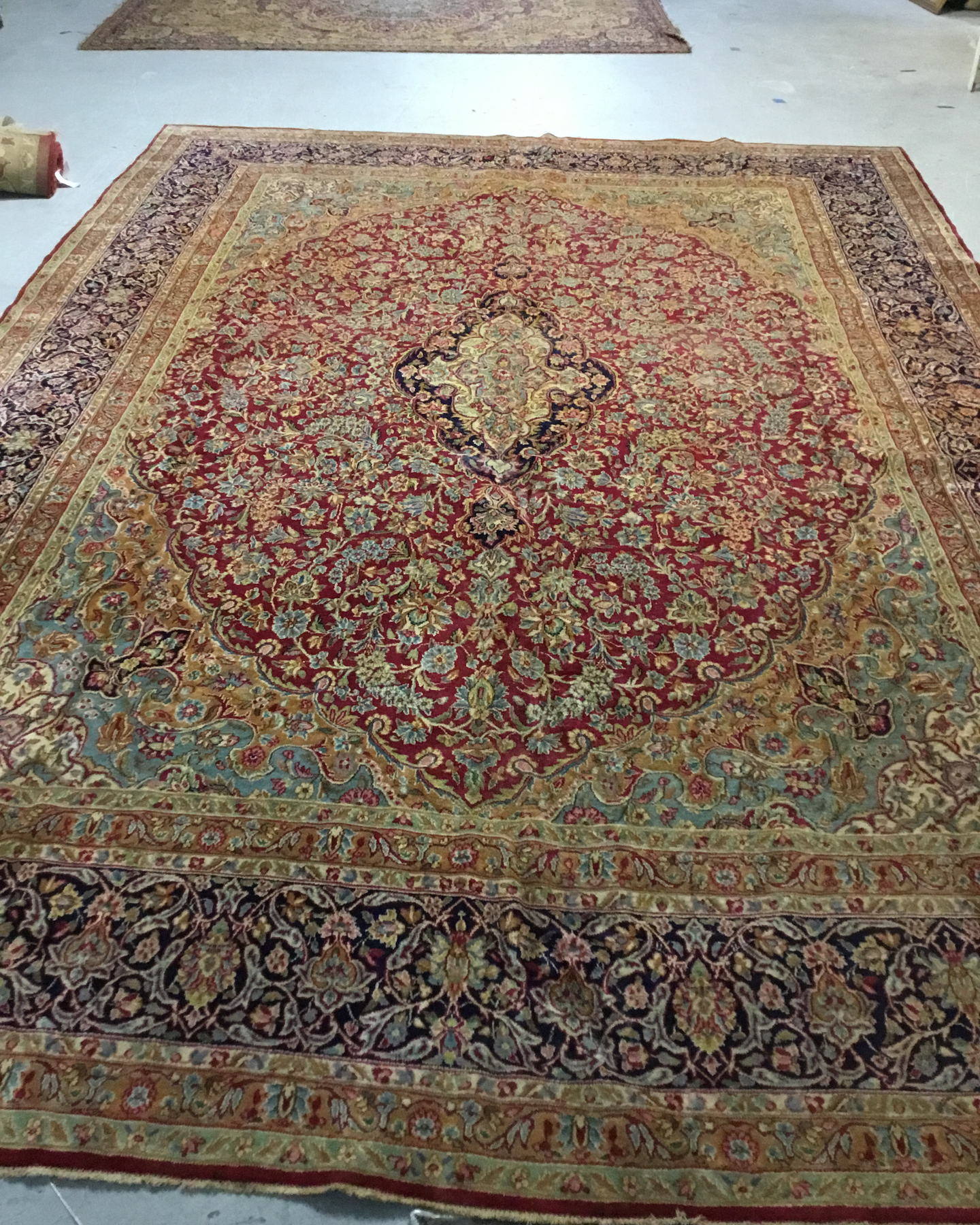
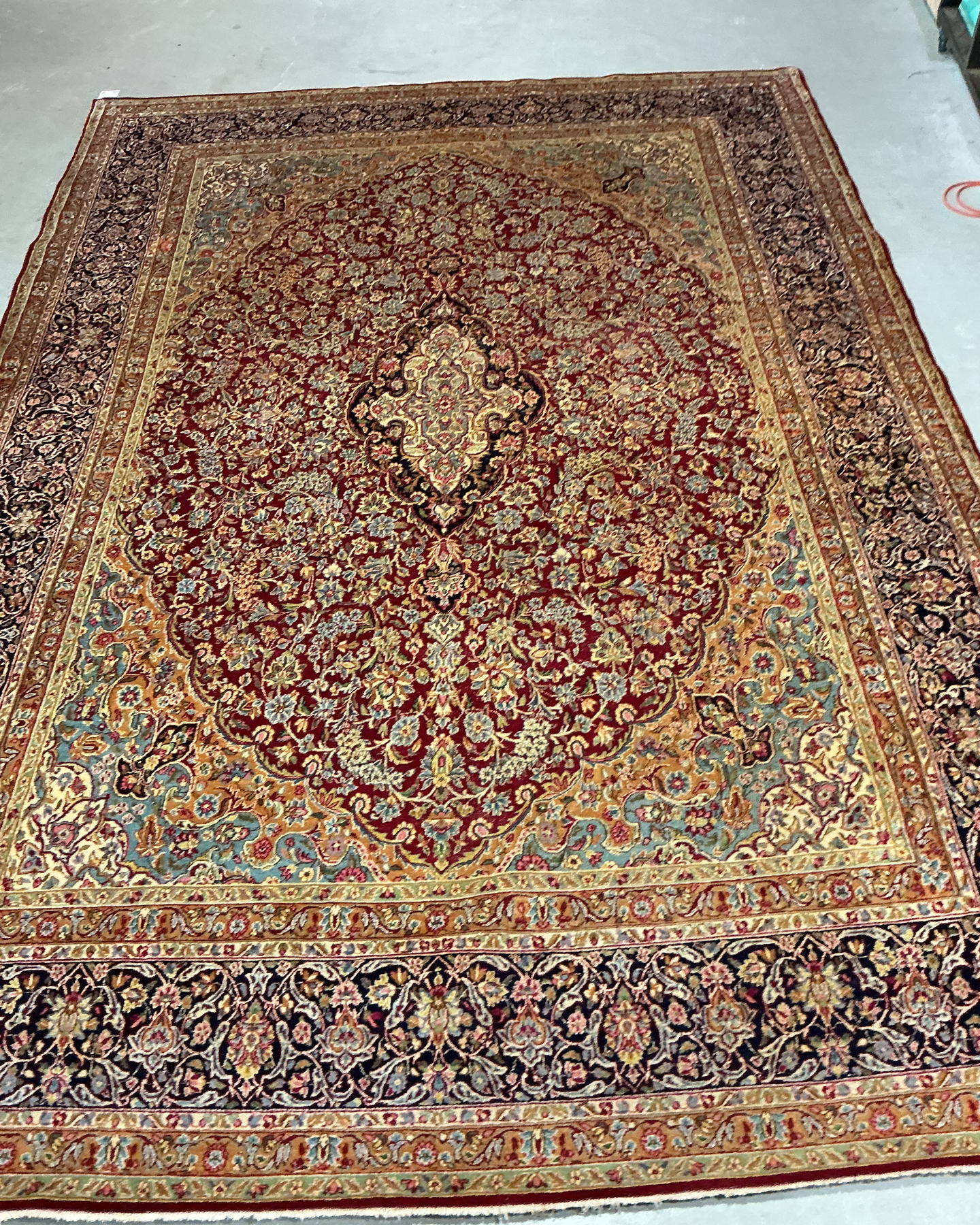
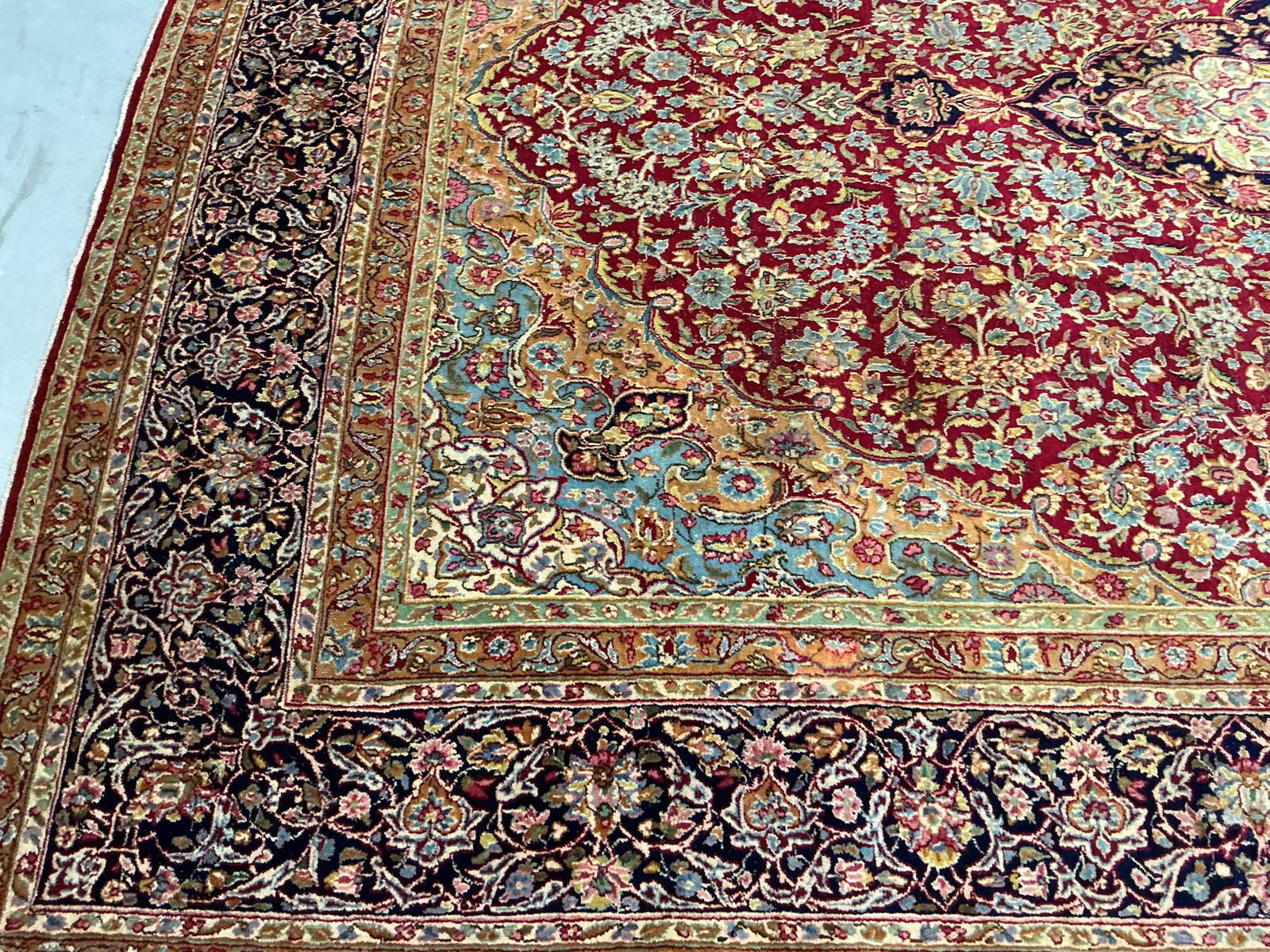
One hand-knotted Persian rug, photographed before and after cleaning.

Before
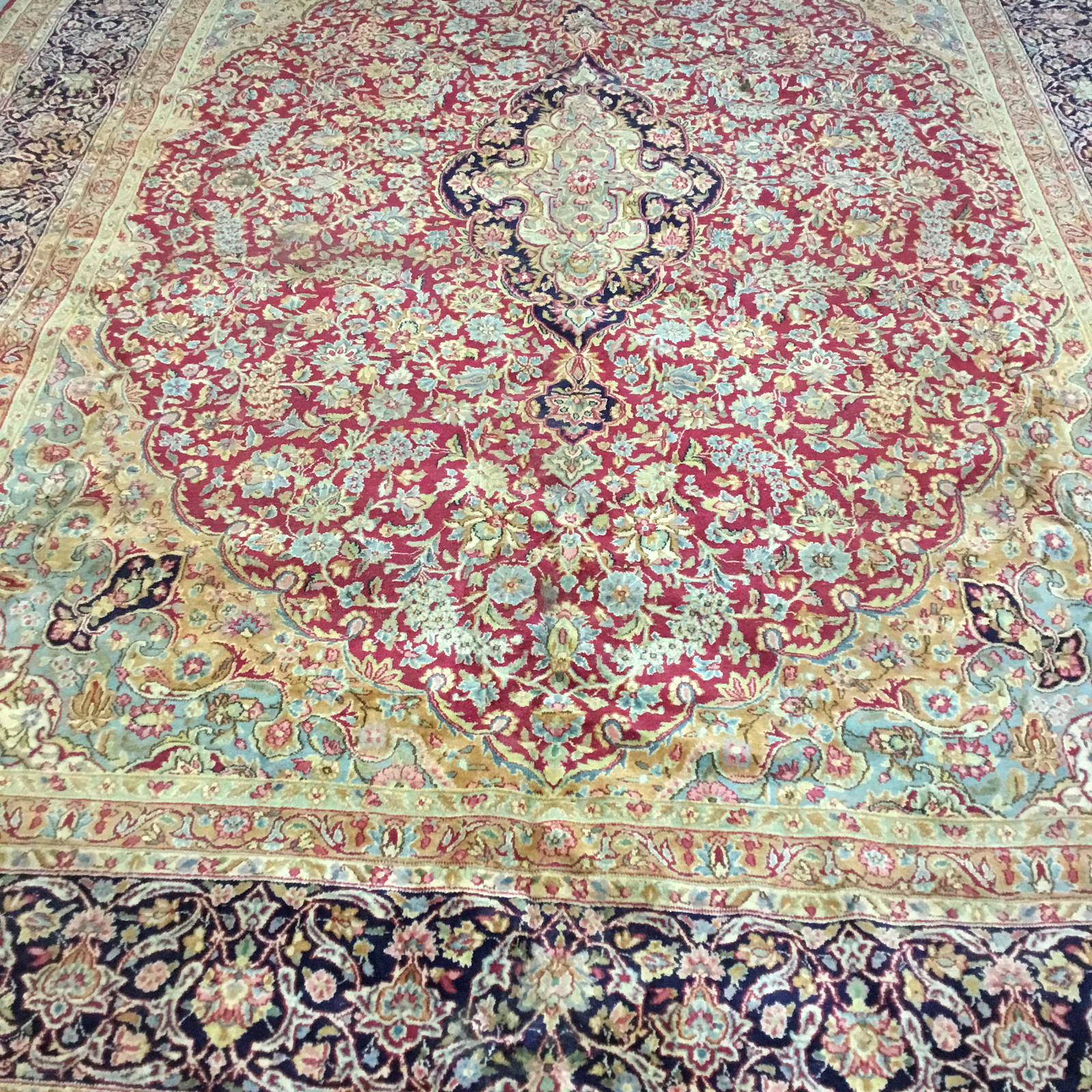
Hand-knotted Persian rug before cleaning, the deep red field and blue-green floral tracery muted and greyed
After
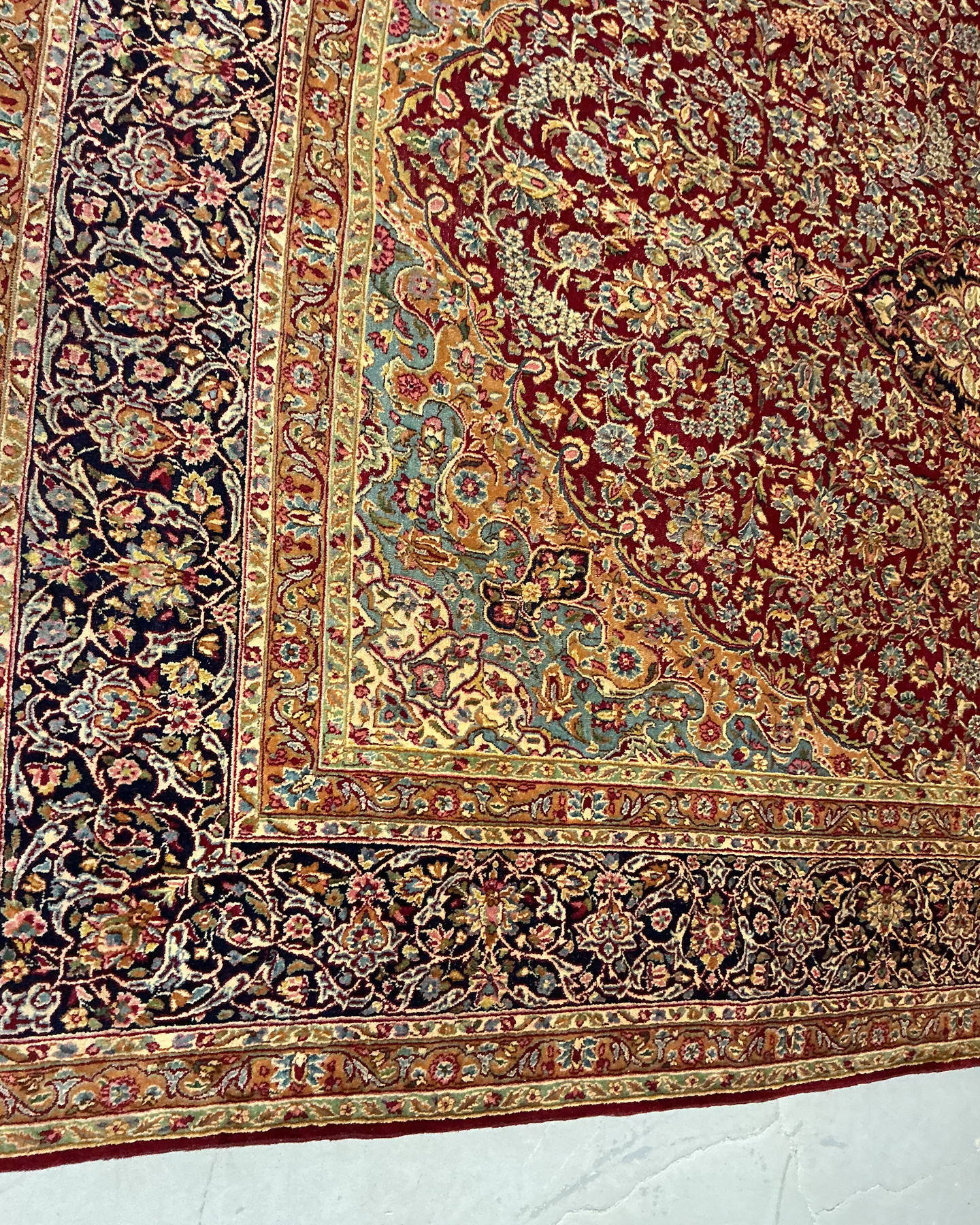
The same rug after cleaning, with the red field, gold corner spandrels and blue-green florals showing clearly
A hand-knotted Persian, before and after cleaning.
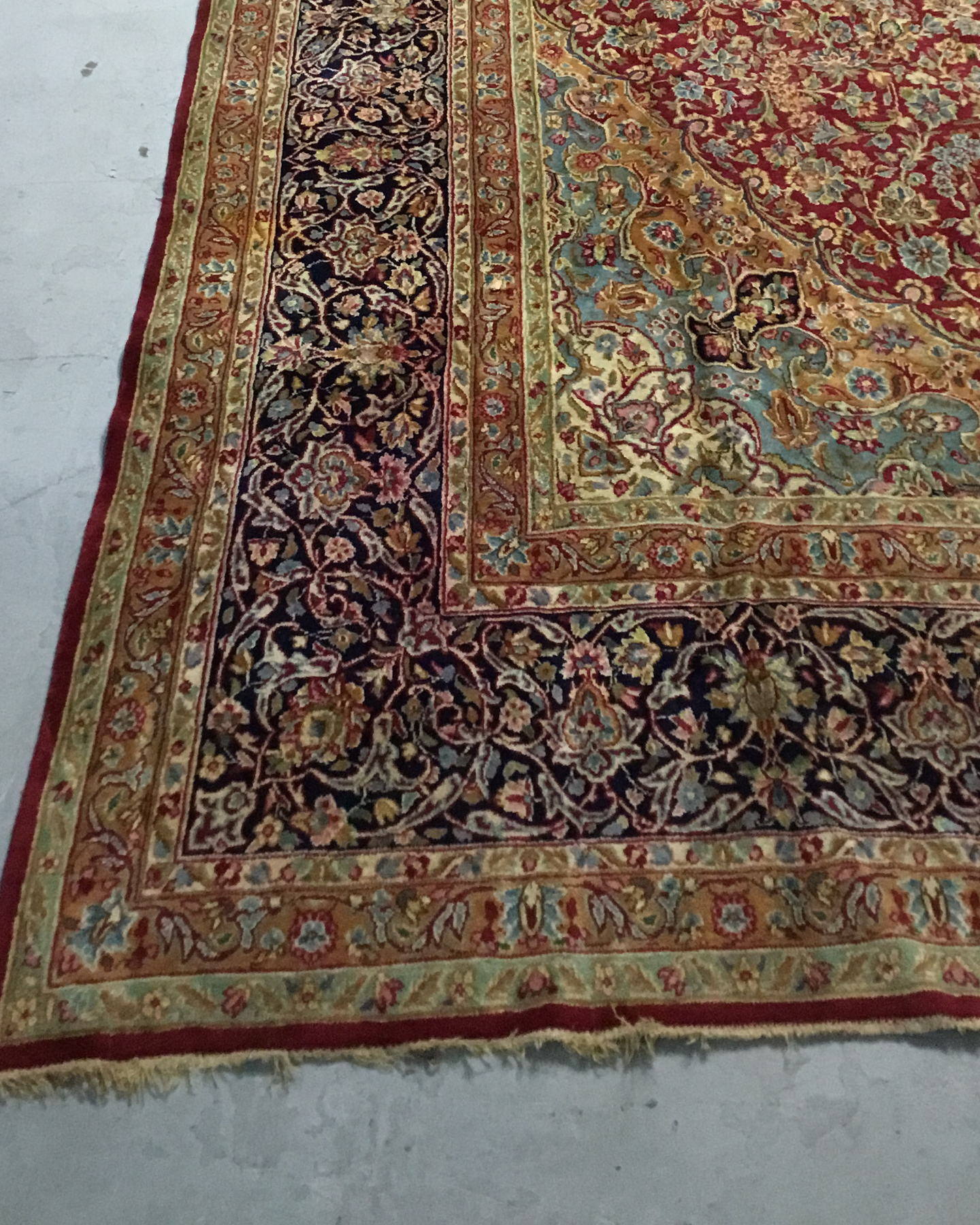
Before
Corner of the same rug before cleaning, the navy border and ivory fringe dulled and flattened in tone
After
The same corner after cleaning, with the navy border, gold guard bands and ivory fringe distinct again
Corner detail — border, guard stripes and fringe.
Before
Centre of the same rug before cleaning, the navy medallion and red field hazy and low in contrast
After
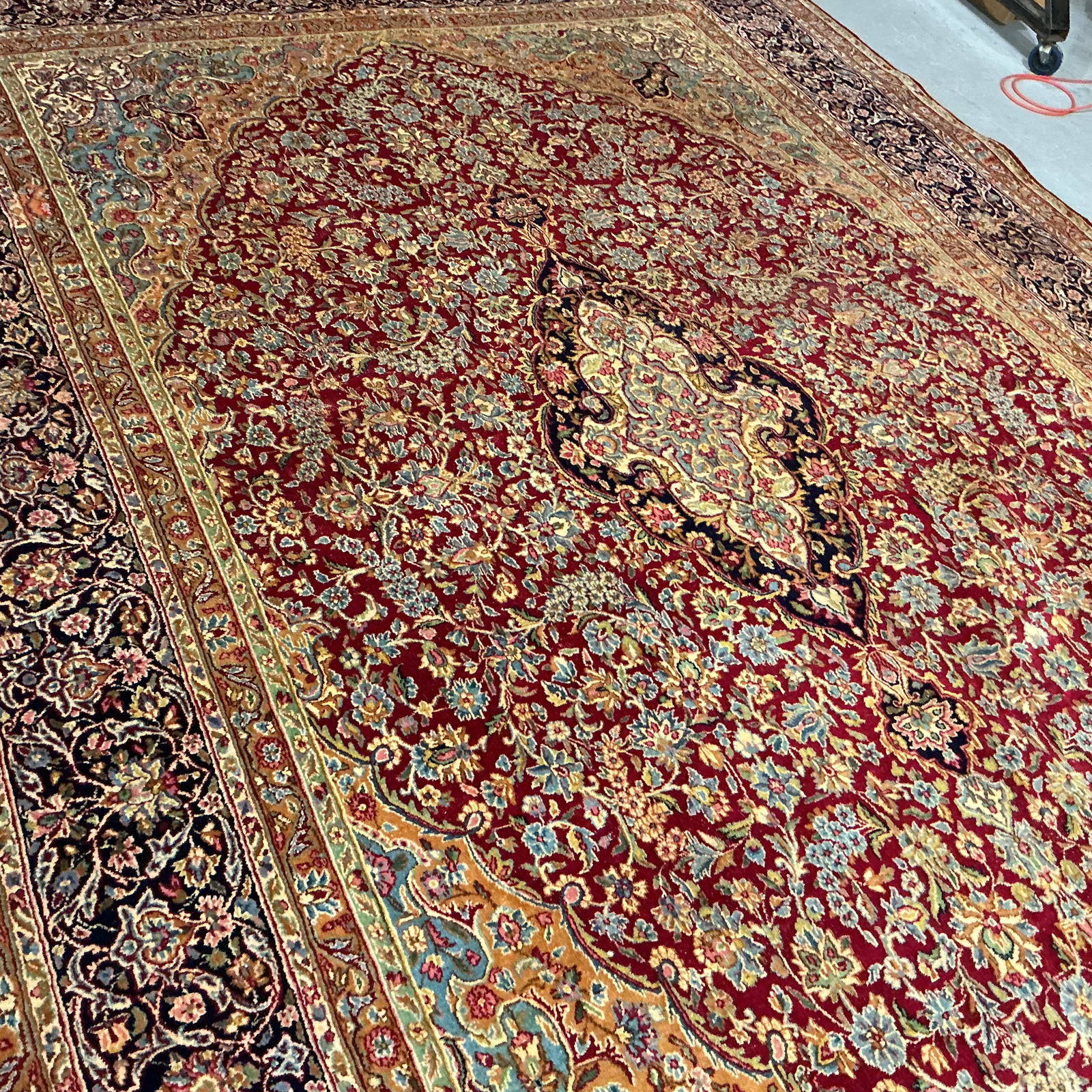
The same medallion after cleaning, the cream and gold palmette reading crisply against the navy and red
The central medallion and the field around it.
Before
Field meeting border on the same rug before cleaning, the blues and pinks greyed and indistinct
After
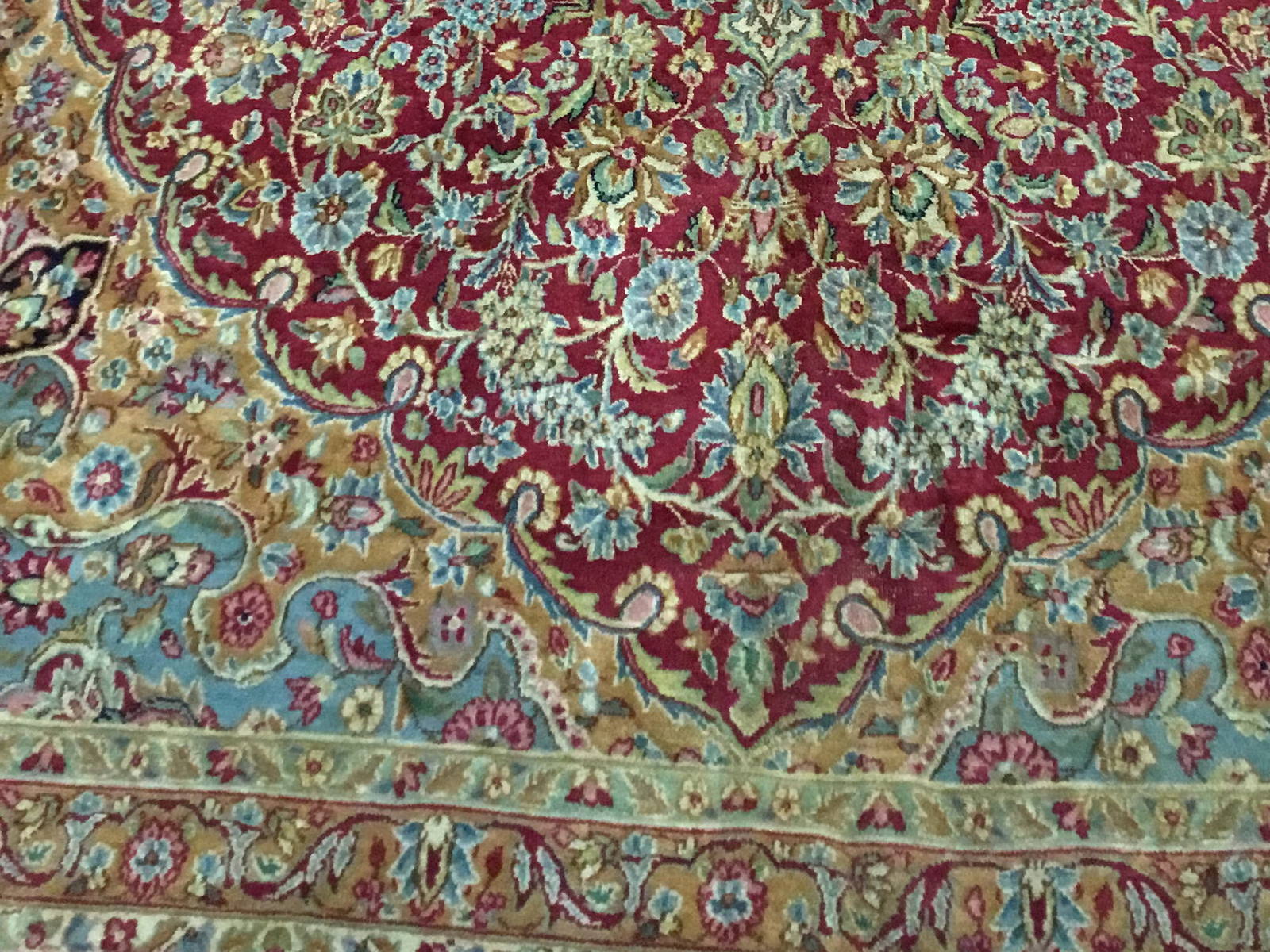
The same section after cleaning, with the pale blue scrollwork and pink florals separated and legible
Where the field meets the border.
Local Conditions

Drying a Rug in Savannah Air

Drying is the hard part of rug cleaning in Savannah, and the reason is one number: the longest unbroken run of days at or above 75% relative humidity in the five-year record is 67 days. For roughly 10 weeks together, the air in this metro will not take much water off a rug, which is why a wash that starts and finishes in your living room cannot work here.

76.2%
Mean relative humidity, five-year average
162
Days a year at or above 80% relative humidity
67
Longest unbroken damp run, in days
141
Days a year with measurable rain

Why it cannot dry where it lies

A rug washed in the room it lives in has to give its water back to that room's air, and for 67 days at a stretch Savannah air is already at or above 75%.

Air that damp takes water out of a rug slowly at best, which is the whole problem with in-home wand cleaning here: the pile dries, the foundation does not, and the rug smells fine for a few weeks and then does not.

The pile is not the part that matters

Wool will carry close to a third of its own weight in water without feeling wet, and on the 162 days a year that reach 80% relative humidity it is doing exactly that.

So a rug that feels dry to the hand can have a loaded foundation, which is why drying is taken to moisture readings rather than to touch, and why the back of a rug tells you more than the front.

Rain, and the trip to the workshop

141 days a year here see measurable rain, totalling 54.3 inches, so a rug leaving the house is wrapped for the weather rather than for the look of it.

It is also why we would rather collect a wet rug than have it wait: a rug that is already damp when it is rolled is in the worst possible condition for sitting still.

The floor the rug goes back onto

Isle of Hope, Skidaway Island and Tybee Island sit close to water, and a rug from a waterside room starts wetter than the same rug five miles inland.

That shows up as odor returning rather than as visible soil, because the source is moisture in the structure rather than dirt in the pile.

On the slab floors that dominate Whitemarsh Island, Richmond Hill and Pooler, the rug is only half the problem.

A slab in contact with ground moisture will re-wet the underside of a clean rug, so a pad that lets air move beneath it does more for the smell staying gone than anything that happens during the wash.

Housing on this route starts in the 1870s, so a fair number of these rugs are drying onto floors that are older than any vapor barrier — a detail worth settling before the rug comes back.

Humidity, rainfall and temperature figures are from the ERA5 reanalysis record for the five years from 2021 through 2025, measured at the center of the the Coastal Empire service area.

What We Accept

What We Take, and How Each Is Treated

Anything that lies on a floor can be washed correctly, provided the method is built around it.

Each fiber and construction that comes in, set against the treatment it calls for.
Rug type How we handle it
Hand-knotted Persian & oriental Dyes proved, then a full bath, and the fringe cleaned by hand. Antique pieces see gentler agitation and a longer spell drying.
Wool area rugs A neutral-pH bath with the lanolin left in place. Strip it and wool loses the very property that makes it shed dirt.
Silk & art silk (viscose) Specialist low-moisture handling only. Viscose turns yellow and goes stiff when over-wet, so it never enters the bath.
Cotton flatweaves & dhurries Moisture kept low throughout and the piece dried under tension, so a weave designed to lie flat either way up cannot pucker or draw up.
Jute, sisal & seagrass Handled dry wherever the soil allows. Plant fiber browns from its own rinse water, and it is the first thing in a Lowcountry house to go moldy.
Hand-tufted rugs Cleaned around the glue layer rather than through it, since the adhesive is what breaks down with age and damp and gives off the old-glue smell.
Machine-made synthetics Polypropylene, nylon and polyester will bear a hard wash and a strong pre-treatment, and the results are usually excellent.
Shag, hides & sheepskin Treated apart from everything else, with agents selected per fiber and the pile lifted again by hand at the finish.
Local Specialties

Problems Savannah Rugs Actually Have

Garden-Level Damp & Marsh Air

A room half a storey below the street sits in old brick with no damp course, and masonry below grade moves water upward continuously. Out on the islands it is the crawlspace doing the same job: the air under a house at the edge of a marsh saturates overnight, every night. Either way the rug is being wetted from underneath, the pile still feels dry to the hand, and the first honest signal is the smell of the room. That smell is microbial growth down in the foundation — it comes out in the wash and is followed with an antimicrobial. Anything sprayed on top lasts until the next humid week.

Pluff Mud & Marsh Silt

Tidal creek mud is fine gray-black silt full of organic matter, and it comes in on boots, paws and anything that has been near a dock. It is not an abrasive and treating it as one is the mistake: the particles are finer than the gaps in the weave, so they pass through the pile and lodge in the foundation. Let it dry and it powders off the surface convincingly, then reactivates the next humid week, because what stays behind is organic. It has to be flushed out front and back.

Pet Urine & Stains

Urine leaves salts behind in the foundation, and those salts draw water back out of the air on every damp day, of which there are 230 a year here. Left long enough they take the dye away with them. On original boards there is a second problem, because whatever went through the rug went into the wood as well. Everything is flushed out of the rug, and the discoloration behind it corrected wherever the dye survived.

The Way the Job Is Set Up

Out of the House, Then Flat

Rugs are collected and washed elsewhere, then dried lying flat in moving air rather than hung dripping or left to dry on your boards.

Matched to the Fiber

Nothing is wetted until the fiber is known and each dye has been proved. Neutral chemistry on wool and silk, and anything firmer reserved for where it is safe.

Collection & Delivery

Chatham and Bryan counties, both directions, included. Narrow lanes and stair-only garden levels are normal here, not a problem.

Nothing Withheld

What the intake found, what the work comes to, and which marks are staying: all of it said before the wash rather than after.

Questions

Questions Worth Answering Up Front

How long will my rug be away?
A timeline comes attached to the quote, before anything is started. Drying is the slow end of it, and slower again through a Lowcountry summer, because the rug leaves when the meter says it is dry rather than when the calendar would prefer. Bad pet contamination, a dye that has shifted, or repair work will each extend it, and you are told so at the beginning rather than partway through.
My house is on a lane with no driveway. Is that a problem?
No. Half this route is houses on the squares with a stoop, a lane behind, and a garden level down a flight of stairs, or island houses raised a full storey on pilings. Say in the form roughly where the rug lives and how you get in, and it is handled at collection. We move the furniture off the rug too.
Do you clean every kind of rug?
Hand-knotted Persian and oriental rugs, wool, silk, cotton flatweaves, jute and sisal, hand-tufted pieces, machine-made synthetics, hides and shag. The wash is built afresh around the fiber in each case, and a couple of them — antique silk most of all — are kept away from immersion entirely.
Are both journeys included in the price?
It is, across Chatham and Bryan alike. We lift the rug, shift whatever furniture is standing on it, and return it rolled and ready to unroll. There is nothing to pay either way.
Does washing risk shrinkage or running color?
Not where the method was chosen for the rug standing in front of us. Each color is proved before the pile is wetted at all, and a dye that will not hold sends the job to low moisture or earns a setting stage. Shrinkage is the result of soaking a cotton foundation and then drying it under strain, which is precisely what drying flat under control prevents.
How often does a rug here want washing?
For a rug in a main room, somewhere between twelve and eighteen months. That is tighter than the national advice, and the reasons are local: 230 damp days a year, below-grade and crawlspace moisture working on the rug from underneath, marsh silt that travels to the foundation instead of resting on the surface, and a heavy few weeks of oak litter every spring. A guest room rug will go two or three years. A rug that has been wet is not on a schedule and should be dealt with now.
Can that musty smell be got out?
In most cases. The smell comes from something living down in the foundation rather than anything on the surface, so it has to be flushed out in the bath and followed with an antimicrobial. A spray hides it for a fortnight and the next damp run brings it straight back. If the foundation has already begun to rot, the answer is repair as much as cleaning, and you will be told which you have. And one thing worth saying plainly: if the room is the source, the rug will smell again in time, and that is a building problem wearing a rug problem’s coat.
What does rug cleaning cost?
It is worked out by the square foot and shifts with fiber, construction and condition, because a machine-made synthetic and a hand-knotted silk are not remotely the same job. A quote is issued before anything begins, the estimate costs nothing, and no extras turn up at the end. Send us the particulars and a number will come back.
Get In Touch

Book a Collection

A rough description and a street is enough to get the rug onto the next run that way.

  • Service area
    Chatham County and Bryan County, Georgia
    Collection & delivery included throughout
  • Hours
    Mon–Sat: 9:00 AM – 5:00 PM
    Sunday: Closed

Free Cleaning Estimate

Up to 6 photos. Close-ups of any damage, stains or wear help us quote accurately without a visit.

Shall We Take It Out and Wash It Properly?

Nothing to pay for the estimate or the collection, and a rug you know again the moment it is unrolled.

Rug Repair & Restoration

Fringe, binding, grazed wool, tide lines and reweaving: what is fixable, and what it takes.

Repair services

Water Damage Recovery

The two days after tidal water, river water or a burst line reach the rug, and how to use them.

Water damage

The Rug Owner’s Guide

Knots, fibers and construction, plus keeping the lot sound in an old house on low ground.

Go to the guide
Start a Free Estimate Service Areas